I’m planning to do something a little different with this space—something I hope will bring homeschool moms a little much-needed clarity—by answering some of the questions I hear most often. I’ve made a list, but if you want to make sure your question is on it, feel free to comment or DM at: www.facebook.com/DiscoverTexasHistory.
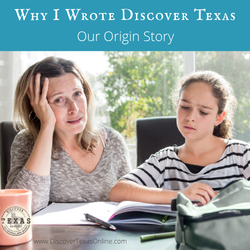
Summer is the season when homeschool families typically plan their curriculum, and I had a big problem.
Because our children were entering 4th and 7th grades, I realized it was time to teach Texas History—not that homeschoolers are required to stick to the public school schedule, but since that’s what their neighborhood friends would be learning (introductory unit in 4th grade and a full year’s study in 7th), I thought we might as well.
The problem was that I HATED Texas History when I was in school. Just the memory of that class made me shudder a little. The un-air-conditioned classroom, first period after lunch. Our teacher, a coach as eager to be outside as we were, sat on his desk and read to us in a monotone voice that droned on as I struggled to stay focused despite the heat and humidity. I tried to follow along in our textbook, but the lines of print trailed on endlessly with only a few blurry black-and-white images to offer any variety. History seemed to be mostly about the names and dates of dead folks and battles for which I had no context. As a consequence, I remembered very little. So how was I supposed to teach it?
At our state’s big book fair, I asked several exhibitors what they recommended. Most of the “big box” curriculums don’t offer state history, but one vendor rummaged through a box beneath her table and emerged with a battered book. “Well, there’s this,” she said, displaying the same old public school textbook that had caused me to hate history almost 30 years before! I was fairly certain it hadn’t improved with age.
Mild panic began to set in.
I didn’t want to make our children hate history as much as I did. I wanted something that would capture their interest and make learning enjoyable…something “meaningful, memorable, and fun.”
I asked other moms what they had used and got the same response over and over—“We cobbled some things together, but I always seemed to find resources a month or two after we’d finished the unit.” They looked apologetic. “Sorry, that’s not much help. If you find something better, please let me know.”
One of those friends had moved to Texas from another state. She added, “If you find something, we’d love to do it with you. I know nothing about Texas history, and I have three kiddos with three wildly different learning styles. I’d love to find something that would interest all of them so we can learn it once, all together, love it, and be done.”
So the challenge was on…and it seemed impossible. But it was important to me because my husband loved Texas history as much as I had avoided it. Realizing I probably should have picked his brain in the first place, I asked him why he enjoyed it so much.
“Well,” he said, “it’s always seemed like an adventure story to me. My teacher used a comic book as our textbook. Tons of pictures, and I could see how everything that happened fit together. My dad traveled a lot with his business, so we’d tag along in the summer and go visit museums and old forts and see the places where things really happened.”
That sounded way more fun that struggling to stay awake.
“Wasn’t there anything you liked about history?” he asked.
I had to think back to elementary school when we studied Native Texas Tribes. Our teacher brought long poles and a couple of tea-died sheets—nothing elaborate—and let us build a teepee. Then we dipped our hands into colored paints and decorated them. We played in that tent at recess for days!
“That’s it, then,” he said. “Figure out how to teach it like that.”
He made it sound simple.
A plan started forming in my head.
- What if I divided Texas History into historical eras where we could group learning resources together for context? That way parents would always know what was available, and students would understand how everything fit together.
- Then we could just tell the story—an overview of the main points. Who wanted what, why they wanted it, and what obstacles they’d have to overcome to succeed. An adventure with real people facing real challenges … with colored pictures … and a “Read To Me” option … and links to curated articles where kids can learn more.
- Have an activities section that tells students how to make things so they can experience firsthand a bit of what life was like in the old days.
- Thinking about my own children, I wanted them to understand why history is important—why things happened, why it mattered, and what it changed. And I wanted them to form their own thoughts and not just copy mine without thinking.
- Finally, I needed a place to collect lists of all the great resources that are already out there—many of them free. Library books. YouTube videos. Field trip ideas. Maps and coloring pages for lap books and/or younger siblings. All easy to find when you need it.
So that’s what I had in mind when I created Discover Texas.
Maybe some of the needs and frustrations–and perhaps even a touch of my original fear of teaching history–resonated with you, as well?
If so, I’m pleased to tell you that Discover Texas worked really well for our family and, later, it worked beautifully when I used it to teach co-op classes.
In fact, for over 25 years it’s been a top choice for Texas homeschoolers.
I’m very proud of that, and I’m grateful to have found something that’s worked for so many homeschool families.
If you’d like to see more, check us out at www.DiscoverTexasOnline.com.